Power price forecasting course 16-17 June

Build confidence in interpreting power price forecasts, technical signals, and market trends.

Register for Power price forecasting course 16-17 June

Submit your details below to learn more about the curriclum

Forecasting is part of almost every trading, procurement, dispatch, and investment decision in the electricity market. But the value of a forecast depends on how well you understand the method behind it.

Spot price forecasts, forward curves, technical analysis, and long-term fundamental scenarios all answer different questions. They use different data, assumptions, time horizons, and levels of complexity. Knowing when to use each method, and how to judge its limits, is essential for better market decisions.

This live online course gives you a practical overview of the main methods used in power price forecasting. You will learn how electricity prices are formed, how forecasts are built and interpreted, and how technical signals and market analysis can support daily trading and commercial work.

What you’ll learn

This course combines electricity market fundamentals with applied forecasting methods. It covers spot and futures markets, price drivers, regression-based spot forecasting, hourly price forward curves, long-term fundamental models, chart formations, technical indicators, and current market analysis.

Across the live online training, you will learn how to compare forecasting approaches, interpret their outputs, and apply them to different market questions.

This training course will teach you how to:

  1. Explain how electricity prices are formed in spot and futures markets, including merit order, auctions, continuous trading, and forward products

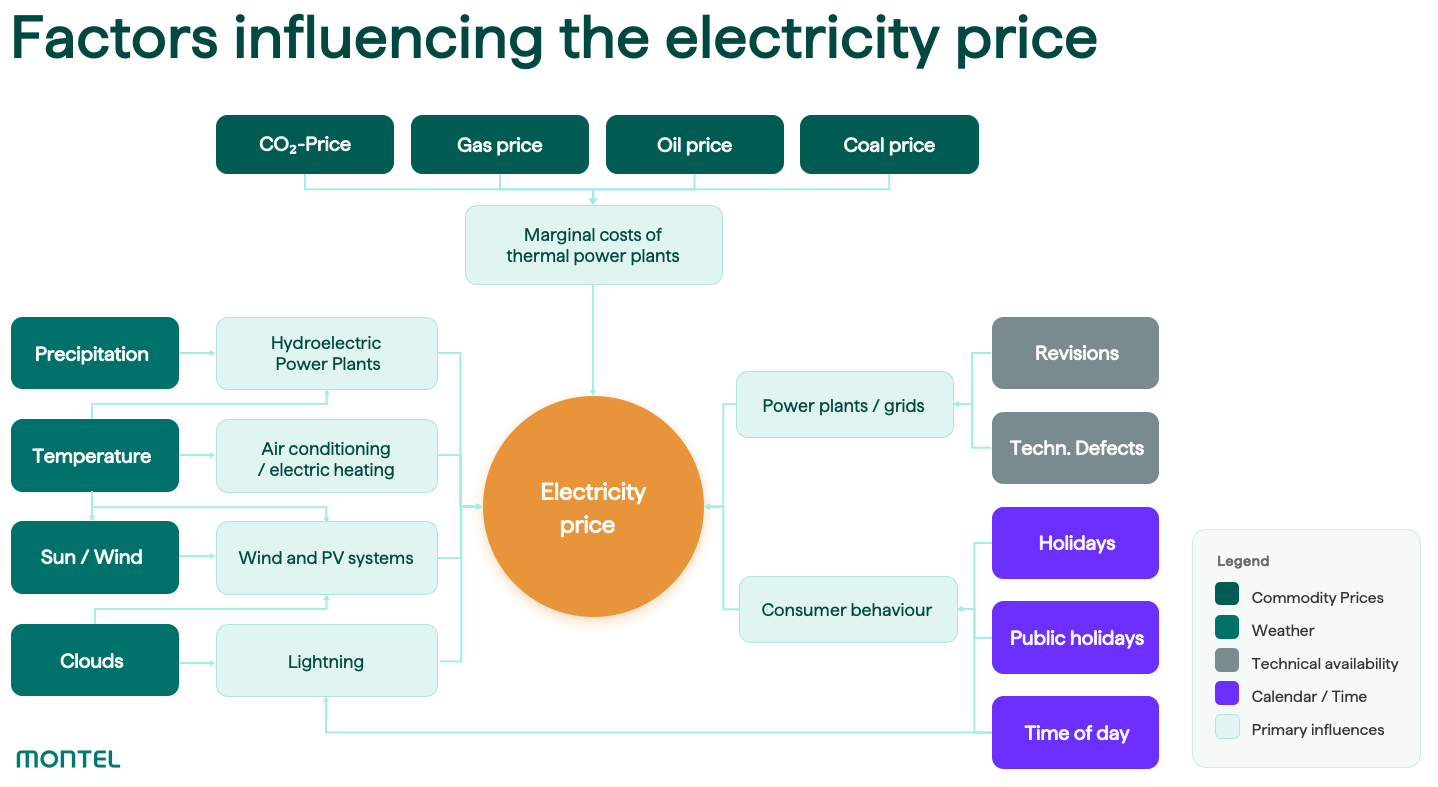
  2. Identify the main drivers of power prices, from demand, weather, and renewable feed-in to fuel prices, CO₂ prices, plant availability, and cross-border flows

  3. Compare key forecasting methods, including spot price forecasts, hourly price forward curves, technical analysis, and long-term fundamental scenarios

  4. Interpret forecast outputs more critically by understanding the role of data quality, assumptions, model design, forecast horizon, and method limitations

  5. Use chart formations and technical indicators to recognise market trends and derive basic trading signals

  6. Apply forecasting insights to practical market questions in trading, procurement, dispatch, portfolio management, and investment analysis

  7. This keeps the full breadth of the course, but makes the section easier to scan and more commercially useful.

You’ll benefit most from this training if you:

  • Are new to electricity markets and need a structured introduction to power price forecasting

  • Work in analysis, trading, procurement, origination, portfolio management, dispatch, or market research

  • Specialise in one area, such as spot price forecasting, and want to understand other methods better

  • Need to interpret forecasts, forward curves, technical signals, or fundamental scenarios in your daily work

  • Work for a utility, supplier, generator, trader, industrial consumer, consultancy, financial institution, or market analysis team

  • Want to speak more confidently with traders, analysts, modellers, procurement teams, or commercial teams

  • Need a practical overview of forecasting methods, data needs, time horizons, and commercial use cases

This course is a good fit if you want to

  • Build a clearer understanding of electricity price forecasting across spot and futures markets

  • Choose the right forecasting method for the right market question

  • Interpret and compare forecast outputs with more confidence

  • Understand the assumptions and limits behind different forecasting approaches

  • Use technical analysis and chart formations to recognise market trends

  • Apply forecast insights more effectively in trading, procurement, dispatch, portfolio, or investment discussions

For questions, please contact:

Contents

Session 1: Fundamentals of price forecasting

  • Recap: fundamentals of how spot and forward markets work, merit order & electricity pricing

  • Recap: different price setting principles, including auctions and continuous trading

  • Comparison of electricity price forecasting methods: resource, cost, data base

  • Forecast vs simulation: the subtle difference

Session 2: The principle of spot price forecasting

  • Short-term power price forecasting using linear regression

  • Assessing the relevance of different price influences

  • The limitations of these methods

Session 3: Long-term price forecasting using fundamental models

  • How the merit order approach works

  • How the quality of the input parameters determines the quality of the output parameters

  • Examplary fundamental scenario

Session 4: Using chart formations

  • Line and candlestick charts

  • Creating and recognising seemingly insurmountable price levels

  • Trend lines and channels and their implications

  • Exercises

Session 5: Interpreting technical signals

  • Indicators: Moving Average, Relative Strength Index, Bollinger Bands and more

  • Deriving trading signals

  • Combination of technical signals

  • Exercises

Session 6: Analyse the markets

  • Analysing the current market situation (interactive)

  • Discussing price trends in the commodity and electricity markets

Speakers

Huangluolun Zhou

Expert

Huangluolun Zhou is an energy market expert with a background in industrial engineering and electrical power engineering from RWTH Aachen University. His work focuses on fundamental analysis, scenario development, storage technologies, and energy market simulations.

He has worked as a business analyst in technology and management consulting and is the founder of a software company for energy market simulations. Since May 2021, he has focused on fundamental electricity market analysis and regularly delivers training on electricity and energy markets.

His teaching combines market fundamentals, modelling logic, and practical interpretation, helping participants understand how forecasting methods can be used in real market decisions.