
The price of grid compatibility: what revenue losses do ramp-rate constraints cause for BESS?

Batteries are highly flexible assets: they can adjust their output within a very short time and thereby respond to market signals. This very responsiveness is what makes them so valuable for our energy system. At the same time, however, this characteristic is not always compatible with grid requirements. Through rapid position changes in the market, batteries can exacerbate local bottlenecks if the grid is unable to keep pace.

April 2nd, 2026
How does battery storage effect power market prices?

The tension between market responsiveness and grid stability

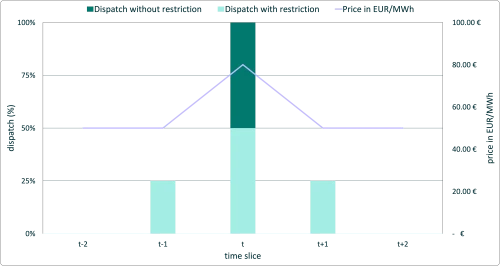
One way to manage potential bottlenecks is through so-called ramp-rate constraints. In this case, the grid operator requires changes in output to be smoothed, preventing abrupt shifts. With a ramp-rate limit of 25%, for example, the charging or discharging output of a quarter-hour interval is reduced from 100% to 50%, while the remaining 25% is shifted to each of the two adjacent time intervals.

This article explores to what extent such constraints reduce the revenue potential of utility-scale battery storage systems. The analysis deliberately considers only the energy-only markets, i.e. day-ahead and intraday trading. Ancillary services are excluded from the following assessment.

The market value of batteries in energy-only markets arises from their ability to switch quickly between charging, discharging and idling, in order to monetise price differences both within and across markets. However, the price structures of day-ahead and intraday trading differ significantly. In the day-ahead market, broader and more clearly defined price windows typically dominate, often reflected in the characteristic “sawtooth” pattern. These usually result from anticipated fundamental factors such as demand, renewable generation, or the availability of thermal power plants. In continuous intraday trading, short-term and highly volatile price signals occur much more frequently, for example due to forecast deviations, weather shifts, or plant outages. These signals are less predictable and are often concentrated in only a few short time intervals.

Methodological approach to representing ramp-rate constraints

To assess the economic effect of grid-side ramp-rate constraints, a deliberately simplified ex-post approach was chosen. The objective is to isolate the effect of reduced reaction speed and make it obvious.

The starting point is an optimal dispatch without restrictions. In this first step, the battery dispatch is determined solely on the basis of price signals, so that price differences can be monetised as effectively as possible. In the second step, this freely optimised dispatch is smoothed ex-post in order to reflect the impact of a ramp-rate restriction. A change in output that was originally concentrated in a single time interval can then no longer be fully executed within that interval, but must instead be distributed across neighbouring time intervals.

Schematic illustration of the impact of ramp-rate constraints on BESS dispatch
Fig.1 - Schematic illustration of the impact of ramp-rate constraints on BESS dispatch

The revenue effect is then derived by comparing both operating profiles against the same price curve. While the unrestricted dispatch can place full output precisely in the high-price interval, the smoothed dispatch shifts part of the energy volume into adjacent time intervals with potentially lower price levels. The economic effect of the ramp-rate restriction therefore does not stem from a change in the price structure itself, but from a temporal dilution of the dispatch.

This approach does not model ramp-rate constraints inherently within the optimisation, but rather applies them ex-post to an initially unrestricted optimal dispatch. This makes the isolated effect of limited reaction speed particularly transparent. At the same time, it should be noted that an optimiser fully aware of the restriction would partially adapt the dispatch strategy, so actual losses would likely be somewhat lower.

Pronounced asymmetry across market segments

The reference case is a stand-alone 2-hour BESS marketed without grid restrictions in the Montel-Central BESS scenario. Under a conservative assumption of two full cycles per day, average revenues of around EUR 180k per installed MW per year are generated across the modelled time horizon. Of this revenue mix, roughly 8–10% is attributable to day-ahead trading and around 60–65% to continuous intraday trading in the scenario considered. The remaining share comes from ancillary services, particularly the aFRR markets.

The ramp-rate constraints considered below, however, affect only energy-only optimisation, i.e. day-ahead and intraday trading. Ramp-rate limits of 25%, 10%, and 5% were modelled. A pronounced asymmetry becomes apparent between the two markets: while the impact on day-ahead trading remains limited, continuous intraday trading responds very sensitively to the reduced reaction speed.

With a 25% ramp, average intraday revenues decline by around 30%, whereas day-ahead revenues fall by only about 1.5%. The same pattern is observed at lower restriction levels: with a 10% ramp, intraday revenues decrease by 12.1% on average, and with a 5% ramp, by 6.0%. By contrast, losses in day-ahead trading remain marginal at 0.59% and 0.28%, respectively.

Revenue losses by market segment for 25/10/5% ramp constraints in 2030, 2040, and 2050
Fig. 2 - Revenue losses by market segment for 25/10/5% ramp constraints in 2030, 2040, and 2050

This result is economically plausible. In the day-ahead market, broader and more persistent price windows typically dominate. Even with a smoothed operating profile, a battery can still capture a substantial share of its market value. In intraday trading, by contrast, many revenue opportunities arise from short, highly localised price spikes. If reaction speed is limited, these signals can no longer be targeted with full output; dispatch becomes temporally diluted, and market value declines much more sharply as a result.

Moreover, the dampening effect of ramp-rate constraints on revenues tends to increase over time. For example, the revenue loss caused by a 25% ramp in intraday trading rises from 21.25% in 2027 to 34.54% in 2047. This suggests that value creation in an increasingly renewable and flexible power system will become more concentrated around short-lived price extremes. As renewable capacity expands, electrification progresses and additional flexibilities such as hydrogen enter the system, short-term market opportunities gain importance. In such a market environment, the economic value of fast reaction speed increases and so does the loss in value when precisely this capability is restricted by ramp-rate limits.

Ramp-rate constraints weaken the business case, but do not break it

Given the ex-post methodology, the present analysis should deliberately be understood as an approximation. A trader or optimiser that already considers ramp-rate constraints within the optimisation would choose a different operating strategy; actual losses would therefore likely be somewhat lower.

Nevertheless, one clear conclusion can be drawn from the results: grid-side ramp-rate limits do not affect all energy-only market segments equally. While the impact on day-ahead trading remains limited, they can cause substantial revenue losses in continuous intraday trading.

For the full-stack optimisation of a 2-hour BESS, this implies a revenue decline of 21.67% in the case considered. In 2027, revenues fall to around EUR 156k per installed MW. This is a noticeable reduction, but it does not fundamentally undermine the business case. It does, however, extend payback periods and reduce the attractiveness of merchant-driven revenue models. If ramp-rate constraints were to be applied more broadly in practice, they would likely dampen the pace of BESS deployment, particularly for commercialisation strategies that are heavily reliant on intraday markets.

To carry out an in-depth analysis of ramp-rate constraints and other limitations, as well as their implications for trading revenues, Montel uses an implicit approach within its FLEXINSIGHT tool. This enables deeper analyses, sensitivities, and stress tests for the battery business case.

Get revenue projections for your BESS project


Verfügbar auf Deutsch