





-
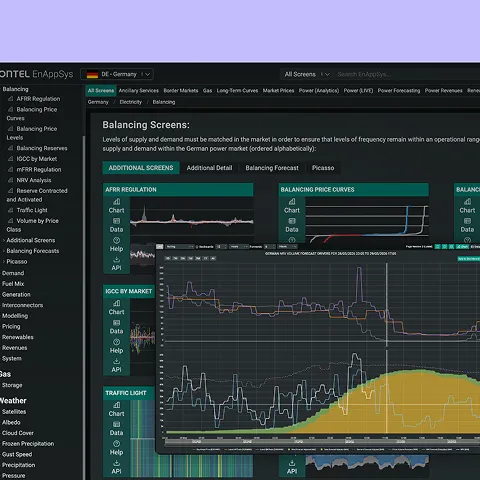
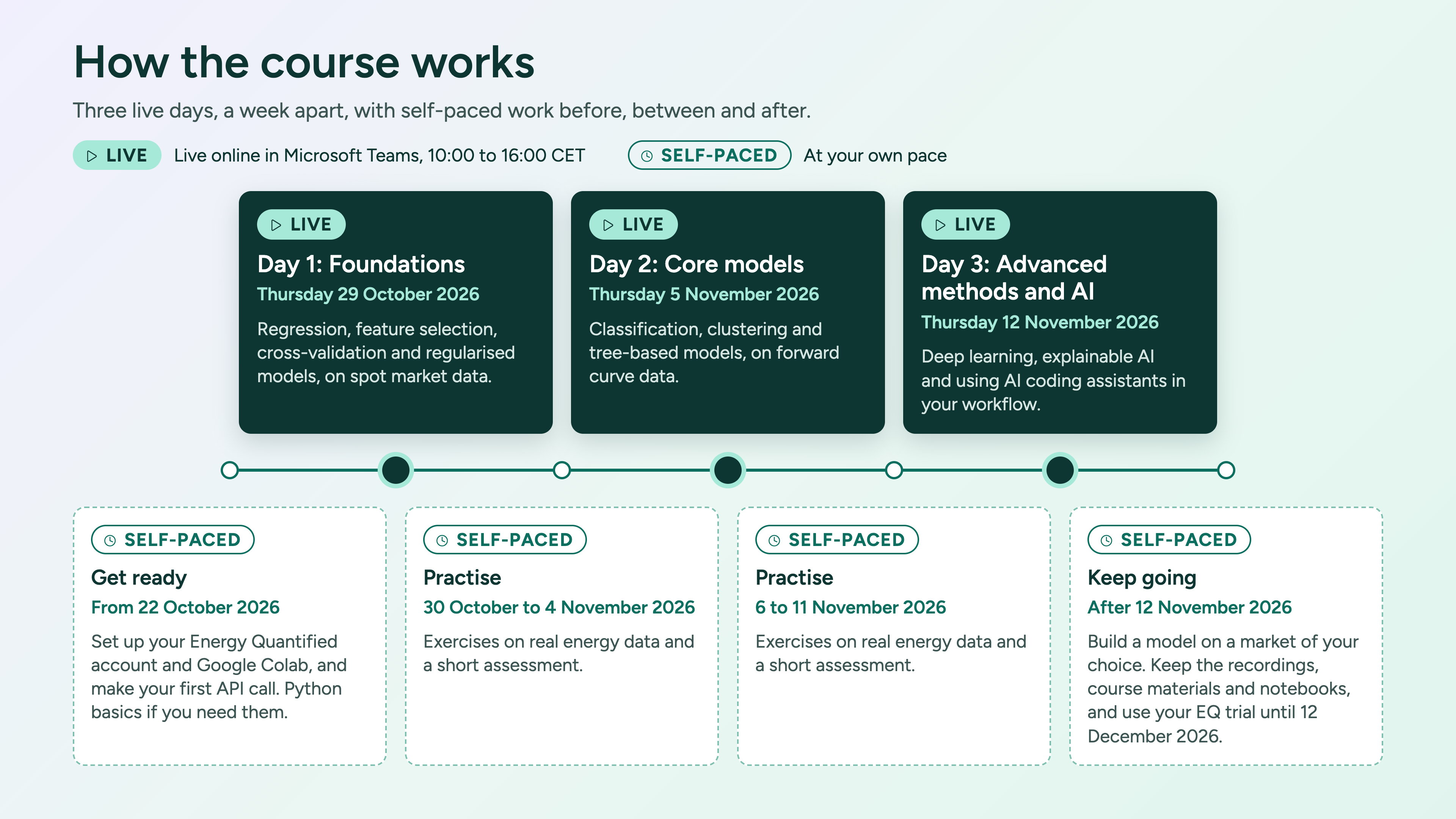
- Warm-up reading (about 30 minutes)
- Technical setup (about 15 minutes): activate your EQ account and API key, and set up Google
- Colab and Gemini in Colab
- A first task: run the setup notebook, which makes your first EQ API call and plots real prices
- Python basics, if you need them
- Your EQ trial starts when you activate your account.
Machine Learning for energy professionals course (New)
Join our founding cohort of this new course with a special price of €999 for three full days across three weeks from 29 Oct till 12 Nov.

Submit your details below to learn more about the curriclum
Energy markets are changing faster than the models built to follow them.
For years, many trading and analytics teams followed the market with spreadsheets and models built on stable price history. Prices behaved in fairly predictable ways, and a manual approach was often enough.
That's no longer the case. More wind and solar means more volatility, more hours with negative prices and more sudden shifts in how the market behaves. The day-ahead market now trades in 15-minute products. There's more data, arriving faster, than any team can work through by hand.
At the same time, AI tools can build a forecasting model in minutes. They can't tell you if it's any good. A model can look excellent in a backtest, a test on historical data, because future data leaked into its training by mistake. Spotting that takes an understanding of machine learning, not a better prompt.
What you'll learn
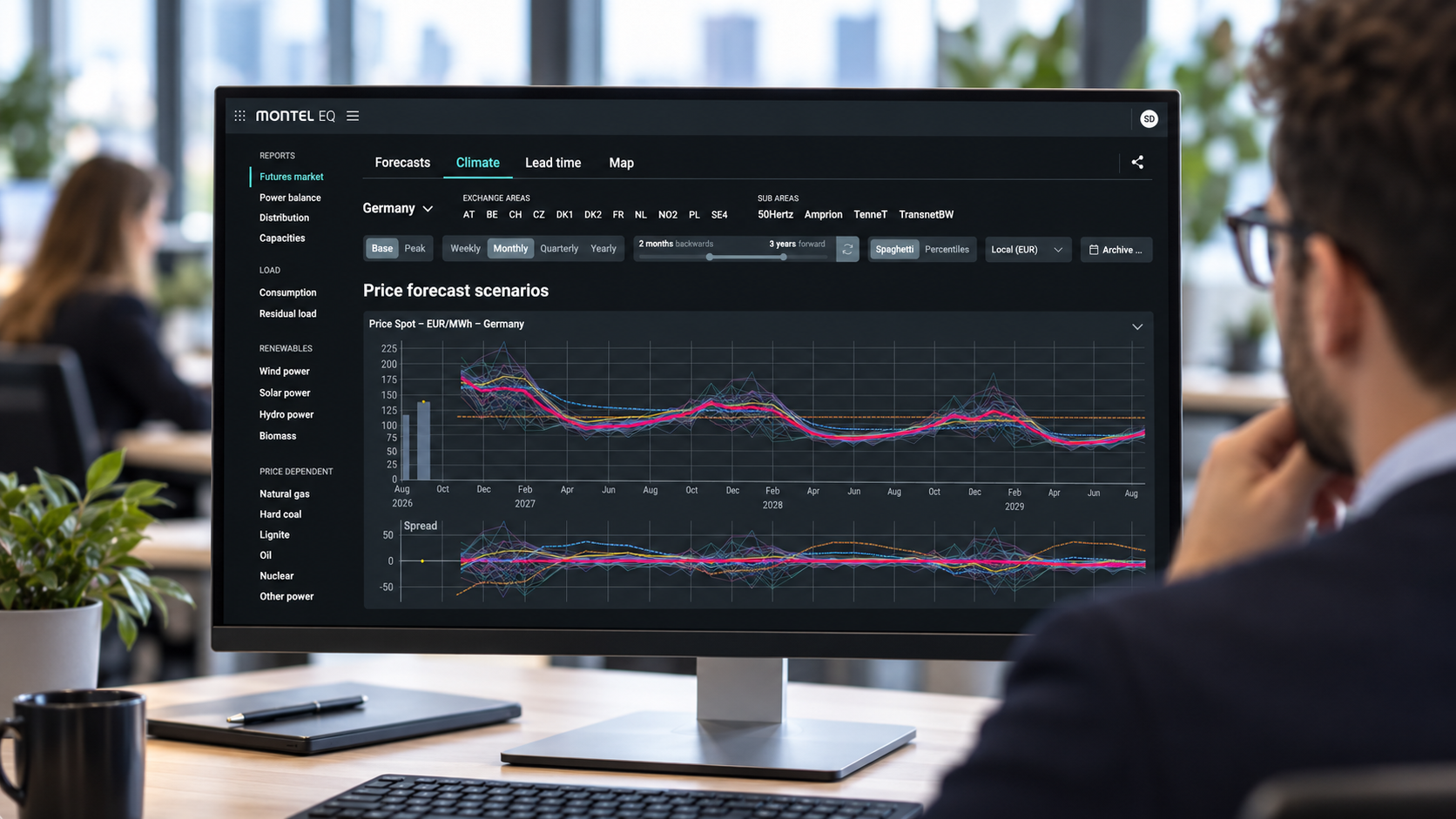
This course shows you how to build, check and explain machine learning models for European energy markets, in a world where AI writes much of the code. It's built for analysts, traders, portfolio managers and risk managers. You work in Python in Google Colab, using real spot prices and forward curves pulled live from the Energy Quantified (EQ) API. Everything runs in your browser, so there's nothing to install.
Over three live online days, a week apart, you move from the foundations of machine learning to tree-based models, deep learning and AI coding assistants. The focus is on knowing which model fits which problem, how to test it properly and how to explain the result.
This training course will teach you how to:
- Decide when machine learning beats traditional econometrics, and when it doesn't.
- Prepare messy data from several sources and turn it into useful model inputs.
- Build and compare forecasting and classification models on real spot and forward curve data.
- Test time series models properly, and spot when a model only looks good because of overfitting or data leakage.
- Explain what a model does, and how uncertain its forecasts are, to traders, risk committees and management.
- Use AI coding assistants such as Gemini, Copilot and Claude to build faster, and review what they produce.
- Pull energy market data straight from an API into your own models.
You’ll benefit most from this training if you:
Work in analysis or trading
- Build or use price forecasts and want a process you can trust, from raw data to tested model.
- Want to test trading signals and spot shifts in market behaviour on spot and forward curve data.
Manage risk or portfolios
- Need machine learning results you can explain and defend in front of a risk committee.
- Want to see the structure in your forward curves and understand how uncertain your forecasts are.
Lead a team or work alongside one
- Head an analytics, trading or risk team and want to upskill it on the data it already uses.
- Work in strategy, commercial, IT or data roles and want to know what machine learning can and can't do for energy markets.
This course is a good fit if you work with energy market data and need models you can trust, whether you build them yourself or brief an AI assistant or data team.
You don't need any machine learning experience, but you should be comfortable working with data and basic statistics. If you're new to Python, the pre-course module covers the basics.
If you are unsure whether it fits your role, just ask. We are happy to help you decide.
For questions, please contact:

Seminar agenda
Speakers

Sjur Westgaard
MSc and Phd of Industrial Economics from Norwegian University of Science and Technology and a MSc of Finance from Norwegian School of Business and Economics

Morten Risstad
Associate Professor Department of Industrial Economics and Technology Management Norwegian University of Science and Technology
Informations

Live online training

October 29, 2026
-
November 19, 2026
Three live sessions from 9:00 - 16:00 on
Session 1/3: 29th of October
Session 2/3: 5th of November
Session 3/3: 12th of November
Self-paced materials to study in between the sessions.

999 (founding cohort offer)
We're offering a limited time price of €999,- for this founding cohort. After that the price for future cohorts will be €2500.
- Live online (MS Teams)
- Self-paced materials and exercises.
- Q&A and group discussion
- Slide deck & resources
- 3 sessions, 6 hours each incl. breaks.
Deadline: October 27th (or until full)