







How flow-based market coupling's hourly capacity clashes with 15-minute pricing
Since the introduction of 15-minute market time units in October 2025 across the Single Day-Ahead Coupling area, most of Europe now clears power prices four times an hour instead of once. However, cross-border capacity hasn't kept up. Flow-based market coupling still calculates and determines the available capacity for cross-border trade hourly, meaning the market can price a solar ramp or demand spike to the quarter hour, but it cannot always transfer power across borders within that same hour to capitalise on these changes.
For traders working across interconnected bidding zones, this isn't a hidden technicality. It shows up directly in price shapes, how far zones converge, and which strategies actually work when a border is capacity-constrained. Understanding why the mismatch exists, and where it bites hardest, is increasingly part of reading the day-ahead market itself.
Why capacity and pricing now run on different clocks
Flow-based market coupling does not simply assign import and export limits between zones. Instead, it models how changes in injection or consumption at one node affect the entire grid, using power transfer distribution factors to estimate how flows are distributed across critical network elements. Regional coordination centres perform this calculation once per day in the day-ahead timeframe. The market is then cleared against these constraints by EUPHEMIA, the single price-coupling algorithm used across the SDAC area. Historically, EUPHEMIA has had about 17 minutes to find a solution across all coupled zones.
That process was originally designed around hourly products. When the day-ahead auction shifted to 15-minute market units on 30 September 2025 for deliveries starting 1 October, most of the SDAC area transitioned to quarter-hourly pricing in a single coordinated move. Ireland, however, remains trading in 30-minute blocks, and Switzerland's transition isn't scheduled until November 2026. Although flow-based capacity wasn't recalculated during this switch, the cross-border capacity available to the auction remains fixed on an hour-by-hour basis. Consequently, all four quarter-hours within the same hour share a single capacity limit, even if conditions change significantly between the first and last quarter-hour.
The core capacity calculation warrants a closer look because it clarifies why this fix isn't just a simple software update. Regional coordination centres assess, for each critical network element and contingency scenario, how changes in injection or consumption at each node affect that part of the grid. They then determine the maximum cross-border exchanges the network can handle without surpassing any limits. This represents a complex optimisation problem, solved once daily for multiple bidding zones simultaneously. The EUPHEMIA algorithm's design was based on processing this calculation once an hour, not four times daily.
This is a known and openly discussed transitional issue rather than a permanent design choice. ENTSO-E and the regional coordination centres have already flagged plans to extend EUPHEMIA's solving window, from roughly 17 minutes to 30, specifically to support finer-grained capacity calculation in future. In parallel, intraday capacity recalculation processes are being developed in some regions to at least partially close the gap between sessions. For now, though, the two clocks are out of sync.
How the mismatch shows up in prices
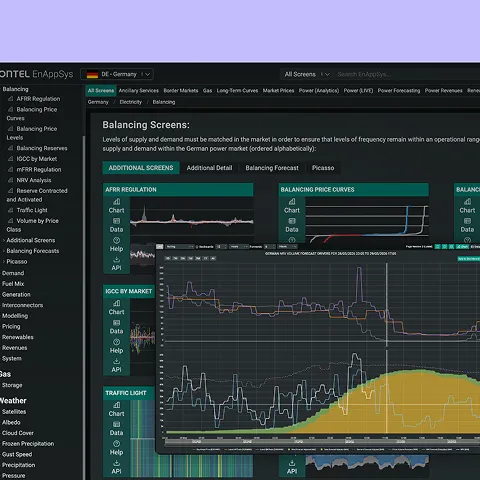
The most noticeable sign is a sawtooth pattern within each hour: prices can vary significantly between the first and last quarter-hours and then reset at the start of the next hour. Solar ramp-ups are the main cause, enabling output to increase sharply within a single hour. In a market with true quarter-hour capacity, cross-border flows could follow these ramps and help smooth the price path. With capacity fixed for the entire hour, such adjustments often cannot reach the border, resulting in intra-hour price swings that are reflected locally.
Conventional generation still influences prices from the other side. A significant portion of thermal capacity is bid into day-ahead auctions as full-hour blocks instead of staggered quarter-hour volumes, reflecting start-up and ramping constraints that remain unchanged despite shorter pricing intervals. When these hourly block bids clear, they tend to anchor the price to an hourly step, even when more granular bidding could smooth out fluctuations. Analysis of the initial weeks of the new system showed that the sawtooth pattern largely persisted, due to this combination: capacity fixed on an hourly basis and generation bidding shaped hourly.
The net effect on price convergence is straightforward. Where hourly capacity limits genuinely bind, quarter-hourly price differences between neighbouring zones can widen rather than narrow, even though the market design nominally supports finer coordination.
Where the mismatch is most visible
Not all European borders are based on flow-based capacity calculations, and the differences are most evident in the Core region and the Nordics - areas where flow-based coupling has been standard for day-ahead capacity for some time. Borders relying on simpler coordinated net transmission capacity methods don't experience the same issues, as their capacity figures were never modelled at the level of individual network components, though they have their own limitations. Within flow-based regions, the impact varies by hour. It is most noticeable during periods of rapid solar or wind output changes, such as around sunrise and sunset, and less so during steadier overnight or plateau periods when generation and demand are relatively stable within the hour, regardless of capacity allocation.
Why the fix isn't straightforward
Recalculating flow-based domains four times an hour instead of once involves more than just increasing the frequency of the process. The calculation is computationally demanding, must be completed within a tight window before gate closure, and depends on coordinated inputs from all TSOs in the region. Existing grid assets, generation portfolios, and forecasting tools were primarily designed and calibrated for hourly operation. Moving to a quarter-hourly cycle impacts TSO procedures, algorithm capacity, and cross-border coordination simultaneously, affecting multiple systems rather than just one.
That is why the extension of EUPHEMIA's solving window is being treated as a staged step rather than an overnight switch, and why capacity calculation itself is expected to lag the pricing change rather than move in lockstep with it.
What it means for market participants
For traders, the practical takeaway is that some of the intra-hour price pattern within coupled zones is structural rather than purely fundamental. It's worth separating the part of a quarter-hourly move driven by genuine short-term supply and demand shifts from the part that simply reflects an hourly capacity ceiling reasserting itself every 60 minutes.
That structural component isn't just a cost to manage. Storage and other flexible assets sited within a single bidding zone, rather than relying on cross-border flows to capture a spread, are less exposed to the capacity mismatch and can be well placed to trade the intra-hour spread the mismatch itself creates. Forecasting and pricing models that lump capacity constraints and price behaviour together risk misreading the sawtooth as a demand signal rather than a network one; separating the two tends to produce a cleaner read on where the next genuine move is likely to come from.
For cross-border strategies, incorporate the mismatch into position sizing rather than ignoring it as minor noise. A spread trade between two connected zones that appears attractive based on a quarter-hourly price differential might not be feasible at the implied size if the hourly capacity was almost fully utilised before that differential emerged. Therefore, evaluating whether the capacity for a specific hour was near its limit is just as crucial for assessing a cross-border spread as analysing the price differential itself.
What's worth checking before acting on this
This is a fast-moving area of market design, and the details are worth confirming against current sources rather than taking as fixed.
- The present capacity calculation cycle time in your bidding zones of interest, and any published timeline for shortening it, directly with ENTSO-E or the relevant regional coordination centre
- Whether the sawtooth pattern has moved in the specific zones and periods you trade, checked against recent market data rather than commentary from the early weeks of the transition
Conclusion
Hourly-fixed cross-border capacity and quarter-hourly day-ahead pricing are, for now, structurally misaligned. That's a transitional limitation tied to the computational and coordination demands of recalculating flow-based domains more often, not a deliberate feature of the new market design. Regulators and TSOs have already signalled they intend to close it. Until capacity calculation catches up with pricing granularity, the sawtooth pattern it produces is likely to remain a recognisable, and in some cases tradeable, feature of the day-ahead market. Verify current alignment timelines against ENTSO-E and TSO sources before building longer-term assumptions around it.