PPA risk & valuation course

Learn how market dynamics, risk allocation, and contract design shape PPA value.

Register for PPA risk & valuation course

Download Syllabus

Power purchase agreements are becoming more important in renewable power marketing and electricity procurement. At the same time, they are becoming more complex. Different delivery structures, profile effects, balancing costs, hedging challenges, and contract terms can all materially affect how a PPA is priced and assessed.

That makes practical PPA knowledge increasingly important for buyers, sellers, utilities, developers, and corporate offtakers. Understanding how value and risk are created and allocated in different PPA models is essential for making better commercial and strategic decisions.

What you’ll learn

This course gives you a practical understanding of how PPAs are priced, valued, structured, and negotiated in real energy markets. It combines market fundamentals with applied valuation, risk analysis, and selected contract design considerations.

Over three live online training days, you will learn how different PPA models work, how profile value and guarantees of origin affect revenues, how key risks influence pricing, and how contractual choices shape commercial outcomes in practice.

This training course will teach you how to:

  1. Understand the PPA value chain and the roles, motivations, and commercial interests of different market participants

  2. Distinguish between utility, corporate, on-site, off-site, virtual, and cross-border PPA models

  3. Explain how electricity prices are formed in the short- and long-term markets and why this matters for PPA pricing

  4. Assess profile value, green attributes, and guarantees of origin as part of PPA valuation

  5. Compare delivery structures such as pay-as-produced, pay-as-nominated, and baseload PPAs

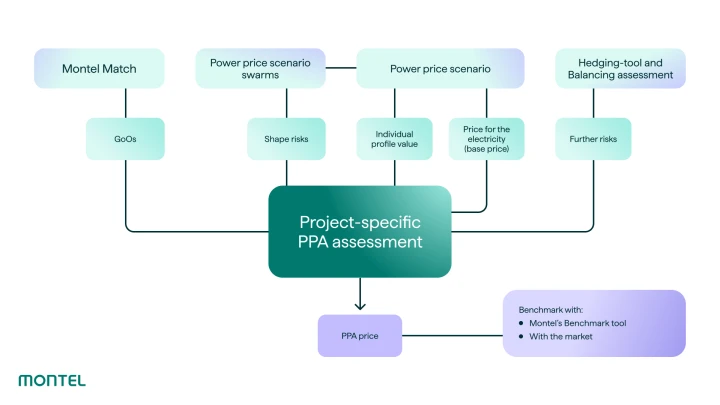
  6. Identify and evaluate key PPA risks, including shape risk, balancing risk, negative price exposure, and hedging risk

  7. Understand how utilities and plant operators manage risk through back-to-back structures, forward hedging, and portfolio approaches

  8. Recognise how contractual provisions around delivery, interruptions, duration, adjustment, liability, succession, and collateral affect commercial outcomes

  9. Better understand the perspective of negotiating counterparties and make more informed decisions in PPA discussions and transactions

You’ll benefit most from this training if you:

  • Work in renewable energy, trading, origination, procurement, or market analysis

  • Are involved in pricing, valuing, structuring, or negotiating PPAs

  • Need to understand how profile effects, market risks, and contract terms shape PPA value

  • Work for a utility, developer, direct marketer, corporate buyer, advisory firm, bank, or large energy consumer

  • Want a stronger practical understanding of how PPAs work in Germany and related European markets

  • Need to speak more confidently with traders, analysts, lawyers, counterparties, or commercial teams about PPA structures and risks

This course is a good fit if you want to

  • Build a more structured understanding of PPA valuation and risk

  • Strengthen your ability to interpret and compare different PPA models

  • Understand how market mechanics and contract design come together in practice

  • Develop a better foundation for commercial, analytical, or negotiation-related decisions around PPAs

For questions, please contact:

PPA seminar agenda

Session 1: PPA value chain overview

  • Overview of PPAs: types, volumes and market data 

  • Motivations and roles along the PPA value chain: from plant operator to end consumer 

Session 2: Basics of pricing and profile value in the electricity market

  • Recap: pricing mechanisms on spot and forward markets, as well as balancing group management  

  • How to value a wind and solar profile 

Session 3: Profile value and green property in practice

  • Case studies of profile value: sales revenues, values & quantities 

  • Guarantees of Origin (GOs) as a source of revenue 

Session 4: Methodology of assessing PPA structures and their risks

  • Evaluation of price and volume risks: example of weather impact 

  • Evaluation of balancing costs: intraday balancing, imbalance energy, negative prices 

  • Case studies: theory vs practice - pay-as-produce vs. pay-as-nominated vs. baseload PPA 

  • Current PPA prices according to PPA price monitor 

Session 5: PPA hedging for energy supply companies and plant operators

  • Value-neutral hedge with Base Parity Ratio (BPR): converting wind and solar into baseload 

  • Liquidity of the forward market and rolling hedge 

  • Remaining risks: implications for PPA structures and negotiations 

Session 6: Recap of sessions 1 to 5 – understanding contract partners

  • Group exercise "Corporate": identifying the best PPA for you

  •  Discussion about the “green” power – looking at examples including the RE100 and regulation for green hydrogen.

Session 7: Contract drafting (with external lawyer)

  • What regulatory requirements must a PPA cover? To what extent are there possibilities for drafting? 

  • How should the bank’s needs be taken into account in the contract? 

  • From the offer to the conclusion of the contract: practical tips for contract negotiations 

Session 8: PPA market outlook to 2030

  • Looking into the future: German and European energy policy 

  • Group exercise "market/regulation“: can PPAs become a mass business?

Session 9: Long-term electricity price development until 2050

  • Group exercise: electricity market trends & their impact on PPAs (for example CO2-pricing, storage, sector-coupling, short term trading)

Speakers

Josephine Steppat

Analyst

Josephine Steppat is an Analyst at Montel, where she works on long-term power price scenarios, PPA valuation, and fundamental electricity market analysis. She regularly supports clients with market-based assessments of Power Purchase Agreements and helps translate complex market developments into practical commercial insights.

In addition to her analytical and advisory work, Josephine speaks at industry events and leads seminars and webinars on electricity markets, PPA pricing, and long-term market developments. Recent sessions have covered topics such as European and Nordic power price drivers, Germany’s negative price dynamics, and the impact of battery storage on future power prices.

She holds degrees in Business Administration, Economics, and Environmental and Resource Economics from Kiel University. Her academic work focused on the German electricity market and the interaction between renewable support mechanisms, spot market price formation, and PPAs.

Target group

  • Specialists and managers from project developers, operators of renewable energy systems, energy suppliers, direct marketers and traders

  • Employees in the energy industry from the areas of energy trading, sales, purchasing, procurement, portfolio and risk management

  • Employees from politics, associations and media

Useful for “PPA beginners”

You are already a specialist in the energy industry and have had occasional contact with PPAs. Now, the topic is becoming more important for you. As a system operator, investor, energy supplier or industrial electricity consumer, you want to understand which steps are necessary to conclude a PPA and which approach is the right one for you. You still lack practical experience with PPAs, but strategic aspects also play a role for you. You are wondering how the PPA market will develop in the next few years and what influencing factors will shape it.