Energy Risk Modelling 2026

How can you measure, model, and effectively manage risk in complex energy portfolios?

Register for Energy Risk Modelling 2026

This intensive two-day course provides finance and risk professionals in the energy sector with a comprehensive understanding of corporate risk management. It blends foundational theory with advanced quantitative methods, empowering participants to identify, measure, and mitigate risks within dynamic energy markets over short-, medium- and long-term horizons.

How to measure and model risk in energy portfolios

More volatile energy markets, combined with complex trading and hedging portfolios have increased the need for measuring risk of individual contracts and whole portfolios, as well as at corporate level (Enterprise risk management).  Furthermore, understanding the dynamics and determinants of volatility, correlation and risk (value at risk and expected shortfall) in energy markets is essential.

Day 1: Energy Markets, Risk Measures & Volatility Modelling

09:00 – 09:15: Welcome and Course Introduction

  • Overview of course objectives and structure

  • Participant introductions and experience sharing

  • Software/tools setup: Excel, R, Python

  • Dataset overview: historical prices futures and spot markets, option markets

09:15 – 10:00: Introduction to Energy Markets and Financial Returns

  • Energy markets overview: electricity, gas, oil, coal, carbon

  • Spot, futures, and options markets

  • Key price characteristics:
    - Volatility clustering
    - Fat tails and skewness
    - Mean reversion and seasonality

  • Return calculation and analysis
    - Descriptive statistics (mean, variance, skewness, kurtosis)
    - Visualization: histograms, time series, QQ plots

Hands-on: Return calculations and visual diagnostics in Excel/Python/R

10:00 – 10:15 Break

10:15 – 11:00: Risk Measures in Energy Markets

  • Key measures: volatility, correlation, VaR, Expected Shortfall

  • Historical vs. parametric approaches

  • How risk evolves over time (e.g. rolling volatility and exponential weighted volatility)

  • Interpreting and comparing tail risk in different markets for long and short positions

11:00 – 11:15 Break

11:15 – 12:00: Volatility Modelling

  • Volatility modelling approaches:
    - EWMA
    - GARCH family (normal, t, skewed t, cornish fisher, evt)
    - Realized volatility from high-frequency data
    - Implied volatility from option markets

  • Model diagnostics and forecasting

12:00 – 13:15 Lunch break

13:15 – 14:00: PCA and Correlation Modelling

  • Estimating dynamic covariances: EWMA, rolling windows

  • Multivariate volatility models:
    - Constant and dynamic conditional correlations (CCC, DCC)

  • Principal Component Analysis (PCA):
    - Interpreting forward curve shapes
    - Reducing dimensions for large correlation matrices

  • Hands-on: PCA on energy futures curves in R/Python

14:00 – 15:15 Break

15:15 – 16:00: Copulas

  • Understanding tail dependencies and non-linear relationships between assets

  • Understanding different stand alone distributions for different assets

  • Risk management using copula models

  • Hands-on: Copula-based dependency modelling in Excel/R/Python

Day 2: Advanced Risk Models, Stress Testing & Portfolio Integration

09:00 – 09:15: Recap and Day 2 Kickoff

  • Key learnings from Day 1

  • Goals and structure of Day 2

09:15 – 10:00: Advanced VaR and ES Models I

  • VaR/ES modelling:
    - Risk Metrics
    - Filtered Historical Simulation (FHS)
    - Cornish-Fisher expansion (CF)
    - Student T models
    - Extreme Value Theory (EVT)

  • Hands-on: Comparing risk models using real energy return data in Excel/R/Python

10:00 – 10:15 Break

10:15 – 11:00: Advanced VaR and ES Models II

  • Quantile Regression (QEG)

  • Semi-parametric Regression

  • Hands-on: Comparing risk models using real energy return data in Excel/R/Python

11:00 – 11:15 Break

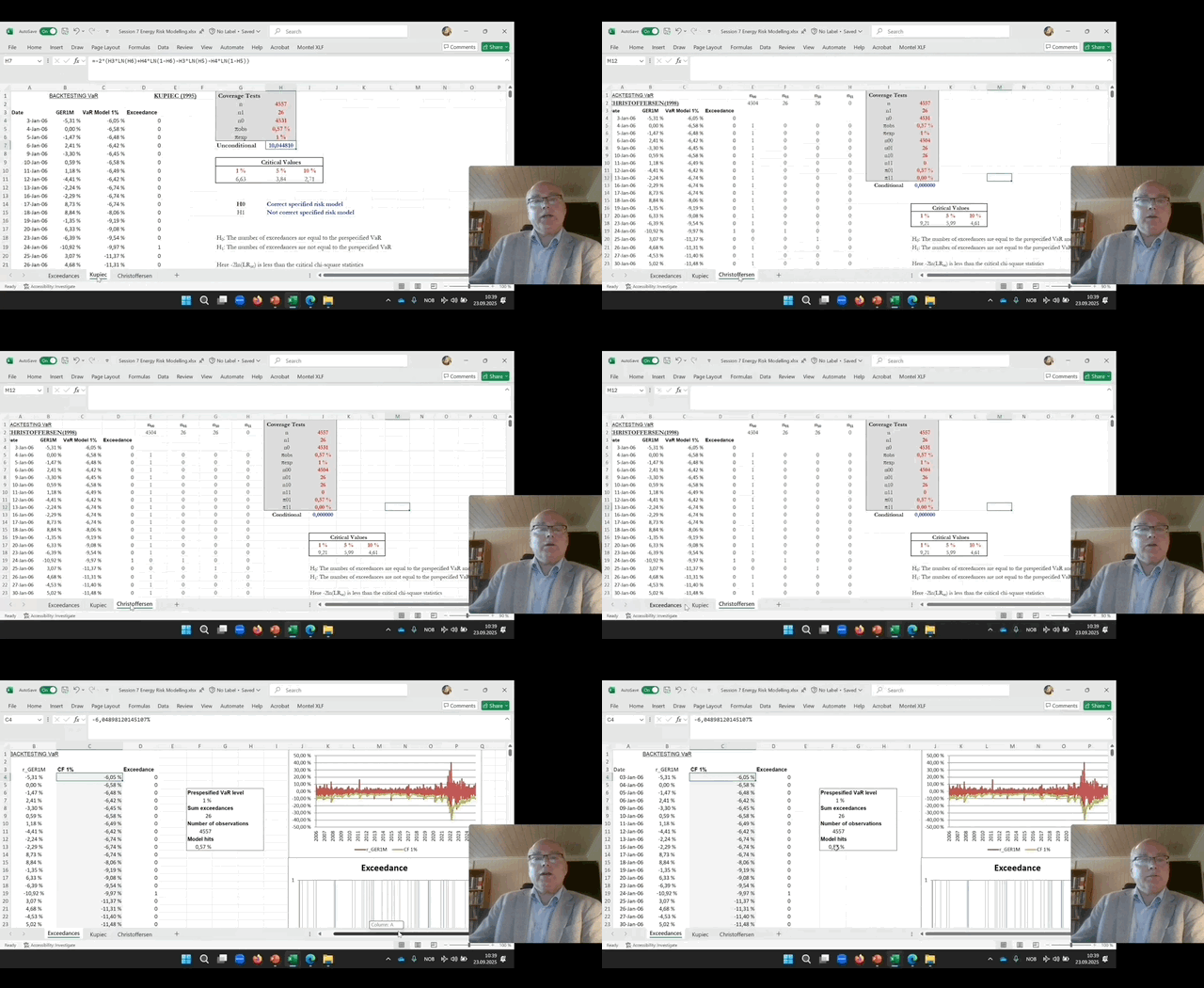
11:15 – 12:00: Backtesting VaR and ES

  • Backtesting process and performance metrics

  • VaR tests (independent tests and Coverage tests)

  • ES tests

  • State of the art regression based tests of VaR and ES

  • Hands-on: Backtesting energy risk models in R and Pyhton

12:00 – 13:15 Lunch break

13:15 – 14:00: Stress Testing and Scenario Analysis

  • Historical vs. hypothetical scenarios

  • Constructing and applying stress tests to energy portfolios

  • Scenario design for geopolitical events, supply shocks, weather events

  • Workshop: Design and implement a stress test for energy positions using R and Pyhton

14:00 – 14:15 Break

14:15 – 15:00: Enterprise Risk Management (ERM) in Energy Firms

  • Integrated risk view: combining price, volume, FX, interest rate, and credit risk

  • Simulating future cash flows under uncertainty

  • Assessing hedge effectiveness and risk mitigation

  • Risk factor mapping and simulation

  • Portfolio aggregation and diversification effects

  • Strategy comparison under uncertainty

  • Hands-on: Cash flow simulation and hedge analysis in Excel

15:15 – 16:00: Future Directions in Energy Risk Modelling

  • Emerging topics in forecasting risk
    - Machine learning in risk estimation
    - Example hybrid models (PCA + Semiprarametric Regression)

  • Hands-on: Advanced risk models in R & Python

16:00 – 16:15: Summary

  • Summary of the course

  • Other topics not dealt with

Speakers

Sjur Westgaard

MSC AND PHD OF INDUSTRIAL ECONOMICS FROM NORWEGIAN UNIVERSITY OF SCIENCE AND TECHNOLOGY AND A MSC OF FINANCE FROM NORWEGIAN SCHOOL OF BUSINESS AND ECONOMICS

Professor Westgaard has previously worked as an investment portfolio manager for an insurance company, a project manager for a consultant company and as a credit analyst for an international bank. Currently he is professor at the Norwegian University of Science and Technology and an Adjunct Professor at the Innland University  – Center for Business Analytics. His teaching involves business economics, corporate finance, derivatives and real options, empirical finance and financial risk management.

He also have bachelor, master and PhD courses on economic and financial forecasting. He is one of the founders and editors of Journal of Commodity Markets. He is also an associate editor of Journal of Energy Markets.  His main research interest include financial risk forecasting. He has recently also been a project manager for two energy research projects involving the research council of Norway, power companies, and academic institutions in Europe.

Morten Risstad

Associate Professor Department of Industrial Economics and Technology Management Norwegian University of Science and Technology