How will the Clean Power 2030 plan impact wholesale trading for GB BESS?

With the UK already playing catch-up when it comes to hitting renewable generation targets outline in the 2030 Clean Power Action Plan, GB Market Expert at Montel EnAppSys, Dr. Jake Thompson explores how this will shape the market and impact revenues for BESS.

December 2nd, 2025
Renewables co-located with storage

Great Britain currently has 5.1GW of battery storage capacity, spanning across 146 BM units.  In Q4 2024, the Labour Government announced their action plan for Clean Power by 2030. In this context, Clean Power is defined as a system with unabated gas-fired generation limited to 5%, with this figure being measured on an annual MWh basis. Clean Power by 2030 is expected to accelerate the decarbonisation of Britain’s generation mix, aiming for 43–50 GW of offshore wind, 27–29 GW of onshore wind, and 45–47 GW of solar capacity. So, what does the future hold for battery optimisation in 2030?

In simple terms, batteries charge when market prices are low and discharge when prices are high. For the day-ahead market, its profile is often described as a “duck curve”. This is because solar generation carries a low marginal cost, increased levels of solar production leads to lower prices during the mid-day. Then approaching the evening, demand rises, and solar generation tails off, leading to higher prices.

For our EU counterparts (NL, DE for example), during the evening peak, the marginal generation source is gas. This, combined with low prices during solar hours, creates high daily price spreads. Historically, day-ahead spreads in GB have been comparatively smaller despite having both solar and gas production. However, the level of solar penetration is not high enough to push gas out of the merit order during the day. As a result, gas often sets the price throughout the day, preventing the occurrence of large price spreads.

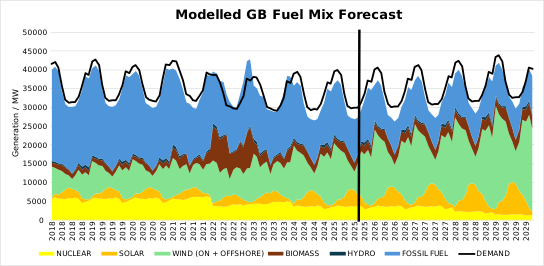
Using the Hydrogen Evolution (Central) scenario based on the Future Energy Scenarios (FES) published by the National Energy System Operator (NESO) for Great Britain and our merit order dispatch model based on the 2018 weather year, we are able to forecast the GB fuel mix giving an approximate view of how the proposed changes may impact the use case for batteries.

Modelled GB Fuel Mix Forecast
Fig. 1 - Forecasted generation mix for GB. All model runs were conducted using a 2018 weather year and the Hydrogen Evolution scenario from FES.

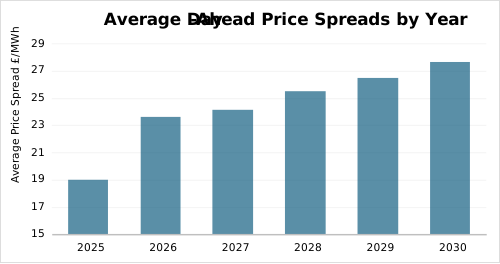
Our forward price model uses historical production data and gas inputs to produce a price - duration curve that calculates average day ahead prices at the 3 hourly level. These 3 hourly prices are then shaped into hourly resolution using the ‘shape’ of the fuel mix reference year. Herein, our forward model suggests that average price spreads may increase by up to 47% (GBP 19/MWh to GBP 27.50/MWh) by 2030. That said, the majority of growth is forecast for 2026. This is largely driven by additional 5.9GW, 1.2GW, and 3.4GW (10.5GW total) of offshore wind, onshore wind, and solar capacities, respectively.

Average Day Ahead Power Price Spreads by Year
Fig. 2 - Average Day-ahead price spreads by year modelled using a 2018 weather year and the Hydrogen Evolution scenario from FES.

Alongside the sharp risers in renewable capacity, BESS capacity is also scheduled to rise significantly. A view of the current acquired capacity obligation by fuel type from the capacity mechanism shows battery capacity could rise to 21GW by 2028. Many batteries follow the same cycling pattern; charge overnight and/or during the solar hours and discharge during the demand peaks. If this behaviour carries on, price spreads will shrink.

GB awarded Capacity Mechanism contracts
Fig. 3 - Awarded Capacity Mechanism contracts in Great Britain

Batteries can deliver various services, including ancillary services: frequency response (Dynamic Containment (DC), Dynamic Moderation (DM) and Dynamic Regulation (DR) and reserve (Balancing Reserve (BR) and Quick Reserve (QR)). Dynamic (frequency) services can only be delivered through batteries because of the requirement of sub-second response times. With the expected influx of battery capacity expected leading up to 2030, this could lead to frequency service markets becoming overly saturated, reducing prices through competitive pressure.

Another market strategy is to go into the Balancing Mechanism (BM). However, with skip rates average around 80 - 90% over recent years, there is absolutely no guarantee the battery gets instructed and even if you are instructed, you may only be required for a few minutes.

I have no doubt that batteries will play a crucial role in wholesale and balancing markets for Great Britain. For the UK to achieve at least 95% of its electricity generation coming from low carbon energy sources by 2030, batteries will be crucial in helping to balance supply with demand on the grid. Capacity market contracts suggest battery capacity could grow to 21GW within three years, putting increased competitive pressure of ancillary service markets. Therefore, developers will need to earn more from the wholesale market, by NIV-chasing or through the balancing mechanism, where rising competition will steadily shrink margins.

Benchmark revenues and optimise your battery storage asset