How solar flipped the peak‑baseload spread

Phil Hewitt, Director at Montel Analytics, explains how Europe’s solar boom has flipped the traditional peak‑baseload price relationship and what that means for generators, consumers and grid planning.

October 1st, 2025
Photo: Dave WoodCraft/Shutterstock.com

Five years ago, the power market looked very different. An energy supplier covering its customer contracts would typically buy two products for each day: a baseload contract for a flat amount of power across 24 hours and a peak contract to cover daytime demand (usually 08:00–20:00). Peak was more expensive than baseload because it relied on less efficient peaking plants that needed higher prices to justify running.

Fast forward five years and the picture has changed, driven by a rapid build-out of solar across Europe, as seen in the chart below. Cheap, easy-to-install solar and the energy crisis have accelerated deployment and upended the old market logic.

volume of solar generation by month in Europe
Fig 1: volume of solar generation by month in Europe
positive power flows from interconnectors into GB
Maximum generation from Solar by month ein Europe

All pricing charts cited here come from spot market auctions and show seasonal averages: summer is April to September, winter is October to March. Data starts in summer 2018.

Rapid solar deployment

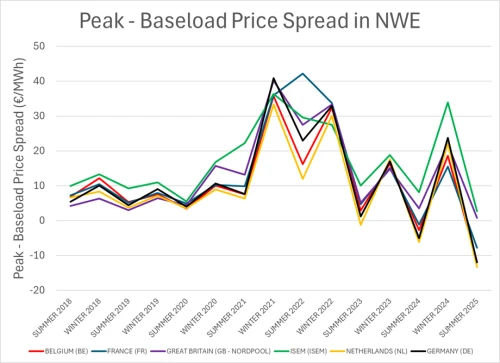
Let’s take a look at northwestern Europe and see how the peak‑baseload spread has evolved. Before the energy crisis the spread was fairly stable at EUR 5-10/MWh, as seen in the chart below. Summer-winter spreads widened sharply during the energy crisis which started in winter 2021, partly because wholesale prices rose across the board. This coincided with rapid solar build-out.

In summer 2023 the spread quickly narrowed and the Netherlands even recorded a negative spread, helped by the fast build-out driven by annual net metering. Since then, coastal markets have continued to see negative summer‑winter spreads as solar capacity climbed and interconnectors exported the low prices. GB and Ireland are now almost at zero spread between baseload and peak and could move into negative territory next year. In the Netherlands and Germany the peak‑baseload spread is about EUR -13/MWh, despite higher consumption in peak hours. Solar reduces net demand by supplying rooftop and distributed load, and conventional generation is crowded out because prices dip during high solar output.

Peak Baseload price spread in NWE

Long solar history

Iberia’s negative spreads trace back to the height of the energy crisis and Spain’s long history of solar deployment. As a peninsular market with links to France, Spain and Portugal have seen summer spreads turn negative from 2022 onwards, this summer registering negative spreads of around EUR 16.5-18/MWh. You can see the price history of Iberia and France in this chart:

Peak Baseload price spread in Iberia

Surpluses flow north

Norway’s prices have traditionally been low because hydropower dominates generation. Before the energy crisis, peak‑baseload spreads were small, then surged as continental demand pulled Nordic power via interconnectors. Now summer spreads are starting to go negative as solar surpluses from Germany and other neighbours flow north – especially into Norway’s NO2 price zone, which has the best connectivity to the continent. In short, Norway’s spreads are increasingly driven by Germany and its neighbours.

Sweden and Finland followed a similar pattern: small spreads before the crisis, larger spreads during the crisis and varied patterns since. Sweden’s four bidding zones behave differently – SE4 tracks Germany and continental trends closely, while SE1 and SE2 align more with Finland.

Across much of central, eastern and southern Europe, the same story plays out: solar build‑out started in Greece and Germany and spread outwards and inwards, creating negative summer spreads as solar capacity rose. This can be seen in these charts:

Peak Baseload price spread in selected CESE countries
Peak Baseload price spread in Sweden/Finland

What next? 

Expect the trend to continue. As conventional thermal plants are pushed down the merit order by midday solar, the historical pattern of higher peak prices will reverse. Many countries plan to roughly double solar capacity over the next five years, cutting middle‑of‑day demand for older plants dramatically. With more batteries in the system, morning and evening ramps should flatten further and cheap midday power could strengthen. 

Timing matters. If electrification and hydrogen rollouts accelerate demand, they could absorb more midday supply and ease the negative spread pressure. Conversely, slow demand growth will deepen the inversion between peak and baseload. Grid reinforcement, storage deployment and market design will all shape how pronounced the spread reversal becomes. 

Follow energy markets across Europe as they move

This article originally appeared as a column on montelnews.com